Home | Articles
Index
Page 1 | Page 2
| Page 3
 The story was placed on an island in
order to limit the player's movements. The title "Myst" came
from Jules Verne's "Mysterious Island," which Robyn had been
reading.
The story was placed on an island in
order to limit the player's movements. The title "Myst" came
from Jules Verne's "Mysterious Island," which Robyn had been
reading.
Myst evolved out of their earlier works but
had much more complexity and depth. They wanted to put together something
that felt like a real world. Rand said, "Robyn and I started doing
"worlds" long before Myst. These were worlds for children that
were kind of whimsical and wacky, but they required very little planning
and forethought. We just designed as we went along. ... These original
worlds didn't have any puzzles. They were simply whimsical environments
to wander around in."
It may have taken only six weeks to work out
the story, but it took two years for the Myst team (Robyn, Rand and five
others) to complete the game.
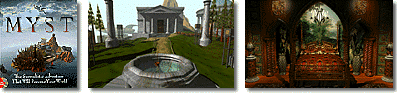
Myst was made entirely on Macs. For rendering
and modeling they used six Quadras. Almost all the scenes were created
as 3-D models using StrataVision 3D. Rand said, "I think we used StrataVision
because it gave us so much control ... The texture capabilities of StrataVision
gave us incredible control over details. Adding wood grain that not only
looks like wood but also reflects light like wood. We also decided early
on that we would ray-trace every image ... and StrataVision does ray-tracing
very well."
Sometimes as many as 30 simulated lights were
used in a room to create the proper illumination and mood. Because of the
complexity of the scenes, it took hours for the Quadras to render each
final image (there were over 2,500 images in Myst). Myst was created in
24-bit color (a palette of millions of colors), but to reduce file sizes
it was later compressed to 8-bit color (256 colors) using custom palattes
and QuickTime compression.
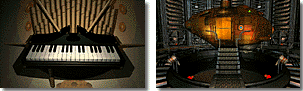
Music and sound effects were important elements
in Myst. Robyn wrote and performed the musical score using an E-mu Proteus
MPS and Master Tracks Pro. It was recorded in 16 bits and then compressed
to 8 bits. (Cyan has recently released a high-fidelity version of the Myst
soundtrack on CD. For information about this and other items in their "Myst
Paraphernalia" catalog, visit the Cyan
Home Page or phone 1-800-219-4119.)
Myst has a linear background story, but the
game is played in a non-linear manner. The player can solve the puzzles
and explore the locations in any sequence. Rand said "The non-linear
structure was rather complex. It had to have a beginning and from that
point branch out (tree) almost infinitely -- allowing for any possible
direction the explorer might care to go (layers)."
Myst's non-linear world with a branching structure
made HyperCard an appropriate choice. Rand said "HyperCard is a great
paradigm for what we do."
"We needed a development tool that could
give us creative and technical control. We chose HyperCard for two reasons.
On a creative level, HyperCard is unobtrusive; from a technical standpoint,
HyperCard has external command capability, so we can customize it and add
the features we need."
"It just so happens that HyperCard doesn't
do color, but that is really an asset," said Rand. "We didn't
have to deal with the speed problems associated with an environment that
tries to provide a complete color solution for everyone. We could customize
HyperCard with XCMDs to do just what we wanted, and do it very quickly.
So we basically use HyperCard as a very powerful shell."
In InterActivity Magazine, Robyn said, "We
got a guy to write XCMDs not only to display color but to turn off some
of the things in HyperCard that we didn't need. Like the black-and-white
bitmap display. That whole part of it was taken away. We didn't need the
screen buffer in there and it really sped up the color for us ... Obviously
we used some QuickTime XCMDs, some color button XCMDs that we had written
for specific points in the game. Like the map of Myst Island (in the Library),
there's a red line that turns around. That's an XCMD."
"With HyperCard," said Rand, "we
could change a graphic on the fly, or swap a sound and play it again without
creating a cumbersome problem. ... You have the ability to tweak things
up to the very end. ... My hunch is that if we created Myst in C or Pascal,
we would still be working on it."
~~~~~
Myst has been both a critical and financial success. It's been ported
to several different platforms and continues to be a best-seller years
after its initial release.
Cyan now has over 20 employees and is busy
working on the Myst sequel,
which will be ready sometime in 1997. It will be much more ambitious than
the original Myst, with larger, more-realistic worlds, more QuickTime animations,
and more interaction with the characters.
The prototype is being made with HyperCard
and several people from Cyan -- including Rand and two programmers -- recently
visited Apple, where Kevin Calhoun gave them an enthusiastic preview of
HyperCard 3.0.
Will the sequel also use HyperCard as the
runtime engine? Cyan is keeping their options open and won't say at this
point, but Rand said this about Macromedia Director, "...we use it,
but we use it more as a time-based animation tool. We are not time-based
-- that's not the right paradigm for our worlds and how they work. ...it's
going to be tough for any product to compete with HyperCard."
Whatever the future brings, one thing is certain
-- Cyan loves HyperCard!
UPDATE 1/98 -- Since this article was written, Cyan has released Riven, the sequel to Myst. Cyan used HyperCard to create Riven and to test the gameplay. Broderbund (the distributor) then converted it to a proprietary application for the runtime. For more information about Riven, see my other web site -- the Riven Unofficial Home Page.
E-mail me (hcheaven@aol.com) your
comments about this article and they might get printed on my "--Comments"
page.
Related sites: (some info for this article came from these sources)
Cyan Home Page
Riven Home Page
Riven Unofficial Home Page
-- my other web site
Guerrillas
in the Myst -- Wired Magazine article
HyperCard ... Enables
Cyan... -- Apple article