
by Robert Howe and Laura Lunetta
 America Online's HyperCard Forum periodically holds scripting conferences
in which HyperCard-related topics are examined in detail. In most cases,
a HyperCard expert prepares a topic stack for members to download and study
before the conference discussion.
America Online's HyperCard Forum periodically holds scripting conferences
in which HyperCard-related topics are examined in detail. In most cases,
a HyperCard expert prepares a topic stack for members to download and study
before the conference discussion.
 One of the most popular of these
conferences was one held in 1995 on the topic of improving HyperCard's
speed. Robert Howe, who co-authored
the conference stack, graciously agreed to update his stack especially
for HyperCard Heaven and to let us post portions of it here as a text article.
One of the most popular of these
conferences was one held in 1995 on the topic of improving HyperCard's
speed. Robert Howe, who co-authored
the conference stack, graciously agreed to update his stack especially
for HyperCard Heaven and to let us post portions of it here as a text article.
The stack contains tips to enhance
the operating speed of HyperCard stacks, based on information from published
sources and suggestions from HyperCard experts. It is perhaps the best
single reference source on this important subject.
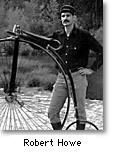
Robert is a computer programer who
works on mainframes for the state of California, but he says he'd much
rather be programming a Mac. He's a member of "The Wheelmen,"
a national organization that's "dedicated to the enjoyment and preservation
of our cycling heritage." His photo, taken at Yosemite in 1986, shows
Robert and his 54-inch 1888 Columbia Expert.
You can read more about Robert and
The Wheelmen at his web site. Robert will be moving his site soon from
[old site] to [new site].

"HyperCard Speed Tips"
130 K download, compressed with Stuffit, requires HC 2.0
The Speed Tips stack contains the
text below plus numerous timed speed demos. The stack may be freely
distributed as long as you don't alter it or charge for it. You can find
a great collection of other scripting conference stacks at Jacqueline Gay's
HyperActive web site.
 f you have a one-time utility handler, you probably don't care if it
takes two minutes to run, especially if it would take you five more minutes
to speed it up to make it run in half a minute! However, if there is a
handler you use frequently, spending a little time to speed it up is well
worth the effort.
f you have a one-time utility handler, you probably don't care if it
takes two minutes to run, especially if it would take you five more minutes
to speed it up to make it run in half a minute! However, if there is a
handler you use frequently, spending a little time to speed it up is well
worth the effort.
I've classified speed improvement methods
into five categories:
1) Reduce disk access
2) Code efficiently
3) Compile code
4) Workaround limitations
5) Smoke and Mirrors
Most of these (but not all!) are described
in both the HyperCard Script Language Guide (for HC 2.2: see pages
555 - 560), and HyperTalk 2.2: The Book (pages 39 to 54). These
two books are my primary references for this scripting topic stack, along
with my (Robert) hard-earned experience and the helpful advice of AOL HyperCard
Mentors Brian Molyneau and Brett Sher.
I'm going to describe the methods of improving
HyperCard's speed. If you download
the companion stack you can run demos which show you what you can expect
in the way of time savings.
1. Reduce Disk Access
HyperCard is a disk-based application. That is, some of your stack is
held in memory at any time; most of it stays on your hard disk. Allocating
more memory to HyperCard (via the Finder's "Get Info" window)
allows HyperCard to keep more of your stack in memory. For the record:
disks are slow, memory is fast.
The alternative to increasing HC's memory
allocation (or using a RAM disk) is to reduce the activities that cause
HC to access the disk.