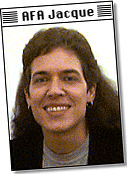
e're pleased to present the first in a series of HyperCard Heaven interviews. Our guest, Jacqueline Landman Gay, lives in Minneapolis where she's the owner of HyperActive Software.
Jacque (pronounced "Jackie") is also a staff member at America Online's HyperCard Forum, where she's known as AFA Jacque. She's a frequent contributor to the forum's message boards, where she uses her extensive knowledge of HyperCard to answer questions from both beginners and experts, and her sense of humor and warm personality help to create a feeling of community among those who frequent the forum.
When did you get your first computer?
After college I worked in social services in a variety of capacities until my son was born, when I quit working in order to take care of him. Shortly later, my husband mentioned that he would like to buy a computer. I was against it. I figured that all he'd do was play games, but he bought a brand new, top of the line, Mac SE anyway.
You hadn't studied computing in college?
I was a Speech Pathology major and graduated with a BA in Communications. I never did use the speech pathology thing, since I decided in the middle of my senior year that I hated it. I learned a lot about how people communicate, though, and that translates surprisingly well into software considerations. Software is nothing more than an interface to help people communicate with computers, and the more you know about how people want to interact, the better your software is.
So what did you think of the SE?
We got it set up easily and then I picked up a couple of plastic rectangles. "What are these?" I asked him. He knew ten times more about computers back then than I did. "I think those are floppy disks," he said, "they hold data." "How do we put it in?" I asked. "I don't know," he said. We dove for the manuals and my self-education began.
Did the SE have HyperCard?
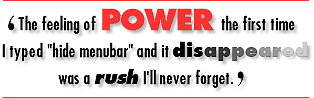
Yes, it came with HyperCard 1.0. It was fun. Since the only other software I owned at the time was one of those "works" programs, I spent a lot of time with HyperCard. Back then you had to order the scripting manual separately, it didn't come with the HyperCard user manual. I sent away for it and then memorized it. The feeling of power the first time I typed "hide menubar" and it disappeared was a rush I'll never forget. After that, it was just a matter of refining my skills.
When did you start HyperActive Software?
I started it within a year after we got the SE. I'd been spending all day every day with HyperCard, and I'd run out of personal projects so I thought I'd start doing other peoples'. I had already written my husband your standard everybody-writes-one checkbook, which he still uses, and I was done with the requisite recipe and menu planning stack that beginners always do. That one actually brought in some shareware fees -- two, I think. I started putting the word out on local BBSs that I was available and began getting a few requests for work.
Did those books lead to more shareware payments?
No, but it was nice to see my stuff in print, and as word got out, I started picking up more business.
What are your typical projects?
I've done a couple of projects that clients are reselling commercially, but most of my work involves solving a particular in-house problem for a company. That's the beauty of HyperCard. Some of these companies could never have afforded to invest the dollars for a C++ programmer to write some of the things I've written. But they can afford me, because I can do in days what other programmers would need weeks or months to accomplish.
article concludes on next page