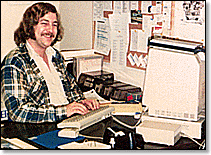
Here's a picture of me in my office at Tetra Tech, Inc., circa fall
1984, with my newly upgraded "Fat Mac", 512 of RAM, 400K external
disk drive, 1200 baud modem, ImageWriter printer, and 20MB hard disk --
a pretty awesome system in those days. The whole setup cost more than $5000!
:)
How did you get involved with PostScript programming?
When the LaserWriter came out in 1985, it cost more than $5000. I had to
spend a year working with several different print shops before I could
get my boss to approve purchase of one for me. I cut a deal with our local
Infomax computer center to use their LaserWriter from time to time. For
those who've frequented CompuServe's HyperCard forum over the years and
know Brad Doster from there, this was where Brad worked. I probably got
him in trouble more than a few times 'cause I'd sit in the store for hours
tweaking my printouts and reprinting and generally just being in the way.
:)
 The LaserWriter was cool; it had a PostScript
interpreter inside it that you could get too (still can I think). When
I discovered this, I promptly went out and got the PostScript Red Book
and Blue Book and started teaching myself PostScript programming. By then
an AlphaGraphics PrintShop had opened in Walnut Creek with one of the first
walk-in Desktop Publishing Centers in the Bay Area. (I think Krishna Copy
over in Berkeley was the first but it was a little farther away than I
generally wanted to travel.) So, I started going into the AlphaGraphics
and playing with the interpreter in their LaserWriter. The owner walked
over one day and asked how the hell I was able to print text on a curved
path (programs like Illustrator and FreeHand were still a good year away).
I explained about the interpreter and PostScript and he suggested I do
a product for him to sell to his customers.
The LaserWriter was cool; it had a PostScript
interpreter inside it that you could get too (still can I think). When
I discovered this, I promptly went out and got the PostScript Red Book
and Blue Book and started teaching myself PostScript programming. By then
an AlphaGraphics PrintShop had opened in Walnut Creek with one of the first
walk-in Desktop Publishing Centers in the Bay Area. (I think Krishna Copy
over in Berkeley was the first but it was a little farther away than I
generally wanted to travel.) So, I started going into the AlphaGraphics
and playing with the interpreter in their LaserWriter. The owner walked
over one day and asked how the hell I was able to print text on a curved
path (programs like Illustrator and FreeHand were still a good year away).
I explained about the interpreter and PostScript and he suggested I do
a product for him to sell to his customers.
I spent the next week of evenings creating
my first software product -- AlphaTitles. It was a little booklet and disk
of about 20 PostScript "templates". Each template was a short
PostScript program with key variables carefully marked as safe for modification.
Users plugged in their own values and text and then ran the program. It
was kind of crude by todays standards but it worked and I made about $500.
At that point I was hooked and decided it was time to get a little more
serious about my career.
That's when you became a consultant?
Yes, I woke up a few mornings after AlphaTitles started selling and decided
to "just do it" as the slogan goes. I walked into the office
and quit my job with this vague notion of being a computer consultant.
Luckily, my boss both respected what I wanted to do AND didn't want to
loose me. He offered me kind of a sweet deal where I'd take five weeks
off (mostly using my vacation time) to try to start my business, after
which I could come back at a little higher pay rate being obligated to
work only a few hours a week for him (but with the option to come back
full time anytime I wanted). I couldn't have asked for a better safety
net. :)
I spent the next two years consulting for
a variety of firms ranging from the Saint Mary's College Student Newspaper
to a ComputerLand store to personalized training for individuals and small
groups -- always on the Mac of course. Mostly though, I focused on helping
a number of AlphaGraphics stores setup and manage their walk-in desktop
publishing centers and accepting referrals from them.


How did you come to work for Heizer Software?
Chris Jones had been one of my clients at the Concord AlphaGraphics and
Ray Heizer had been one of her regular customers. Ray used to come in and
print out this little catalog of Microsoft Excel Templates on the LaserWriter
-- Breakeven Analysis, some shareware Tax Templates, Internal Rate of Return
calculator, etc. As Ray's business started to take off, he hired Chris
away as his Operations Manager. Pretty soon Chris called me and asked me
to come over to the "office" (actually a walled-off portion of
Ray's garage) as they had some consulting for me. Ray and I hit it off
and I started doing various little consulting projects for him -- working
a MacWorld booth, helping him buy a PC, designing some boiler-plate templates
for Microsoft Word, etc. Shortly after this, Ray's business -- Heizer Software -- really took off and Ray
and Chris moved into a small suite of offices over a restaurant in Pleasant
Hill, California.
How did Heizer Software become involved with HyperCard?
In August of 1987, at the Boston MacWorld Show, Ray had a large number
of people walk up and ask if he was going to build a similar business around
"HyperCard". HyperCard had just been announced during the show
and Ray really had no idea what it was. But, through chance, Ray happened
to bump into Bill Atkinson in the aisles (Bill, as you should know, is
the original creator of HyperCard among other Mac essentials like QuickDraw).
Ray explained his business to Bill and asked if it made sense to do something
similar for HyperCard. Bill said yes.
Ray managed to get his hands on a late beta
copy of HyperCard (it didn't start shipping until towards the end of that
August) and brought it back with him. He called me in and gave me this
disk and said something to the effect of "I think there's a product
line in this thing, why don't you take it away for a week and see if you
agree".


What was your reaction when you saw HyperCard?
I took it back to my office and booted it up -- wow. I was completely floored
by HyperCard. I had this over-powering gut reaction to HyperCard and knew
that I had to work with it. I don't think any software before or since
has made me feel the way I did that day. I played around with this little
stack Bill Atkinson had done of clip art. It had visual effects and buttons
over the art so that when you clicked the images you were taken to other
cards with related images. I figured out how to get into the script editor
and saw the script:
on mouseUp
visual effect dissolve
go next card
end mouseUp
That was it. All that power in just four lines
that to me were written in clear English. It was awe inspiring; I had to
work with this thing.
I went back to Ray and told him there was
a product line there. He hired me on the spot as Product Manager and then
told me he'd already put out a press release announcing Heizer Software
would release the "Stack Exchange" in January with 100 stacks.
It was September and we had no stacks....
So where did you get them?
I spent the next few months pretty much locked in the office trying to
get 100 stacks together. I also, of course, had to learn how to use HyperCard
in the first place. :) I got in touch with David Drucker over at the Boston Computer Society and he sent a whole
slew of disks with all the stacks they had found on the networks and such.
BMUG (Berkeley Macintosh Users Group)
did the same. I spent the first month ripping apart about 40 MB of stacks,
looking for talented authors and studying the scripts to see how things
worked.
What kinds of stacks did you see?
One of the first programs I looked at was something called "Import
Button". Import Button was about like the little button that now comes
with HyperCard in the button library for importing comma-delimited text
-- not real exciting today, but back then it was very cool. Import Button
was written by Steve Michel (Steve went on to write books on both HyperCard
and SuperCard, had a column on HyperCard and AppleScript for some years
in MacWeek, and is now an authority on AppleScript -- although in recent
months he's gotten a real job doing cool net stuff.) I called Steve and
explained the business and Steve quickly agreed to become Heizer's first
HyperCard author. Steve took "Import Button" and transformed
it into "Port Authority" which imported and exported all manner
of data formats. Steve made some thousands of dollars in royalties from
Heizer in those good old early days when HyperCard was free. :)
Steve also introduced me to Eric Alderman
(see the HyperMedia Groups web page)
who had a little program called Script Report. Script Report was able to
quickly extract all the scripts in a stack and dump them out in nicely
formatted text files, even in outliner format as an option. Eric polished
his program up and quickly came on board as an author too. Later, Eric
teamed up with Tay Vaughan and Jim Edlin to form the HyperMedia Group which
is today a very successful Multimedia consulting firm. For those who've
followed Heizer over the years, The HyperMedia Group wrote ConvertIt! for
Heizer (HyperCard to ToolBook conversions).
Other authors followed and I managed to either
write or convert from Excel some 35+ programs myself. When the Stack Exchange
catalog came out in January, 1988, it had over 80 stacks listed -- not
the hundred we promised but a pretty darn good showing. Word quickly spread
and with our rather large Excel mailing list and the fact that the HyperCard
programs were in the same catalog (i.e. lots of leverage from the Excel
side of the business), Heizer Software's Stack Exchange was a success.
Did Heizer also carry developers' tools at that time?
No, the early Stack Exchange was not developer tools as today's Heizer
Software is. Because HyperCard was free, bundled on every Mac, we could
kind of assume that most people had it -- even if they didn't know they
had it. It was kind of like Simple Text today -- double click a text file
and there's at least Simple Text available to open it. It was the same
way with HyperCard in those days. You just double-clicked stacks and they
opened. Today, we have to save as standalones (so the customer doesn't
know they are using HyperCard) or otherwise ensure our customers have at
least the Player which doesn't always work the same as the full HyperCard.
Plus, HyperCard was newsworthy so there was a steady stream of articles,
reviews, news bits, etc. -- users knew about it. It was easier in those
first few years.
So, the first couple of years the Stack Exchange
had all kinds of interesting stacks -- recipe books, music business management
software, check books, a how-to-brew-beer stack, tutorials on how to develop
with HyperCard, a stack for planning networks of computers, a Tarot Card
reader, a stack for managing coupons, a stack that calculated nutrition
for meals at popular fast food restaurants, databases of stock and economic
information, a periodic table, and much more. All of these stacks were
reviewed before being listed (about 70 percent of submissions were rejected)
and each author received a rather sizable royalty (50% in those days, which
is outrageous by todays standards where you're damn lucky if you can get
15%).