Home | Interviews Index
page 1 | page 2 | page 3
What was your first shareware stack?
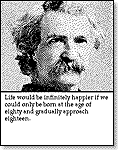 The first stack I had the guts to upload to AOL was
called Mark Twain. It was a collection of about 400 quotations with some
animation and sound, and it was $5 shareware.
The first stack I had the guts to upload to AOL was
called Mark Twain. It was a collection of about 400 quotations with some
animation and sound, and it was $5 shareware.
 Within a few days I received a complementary e-mail from someone named
Alex. He told me that "the check was in the mail" and asked if
I had any others. I noticed that his e-mail address contained the word
"phaedrus." Not being a Greek scholar, my only reference to the
name Phaedrus is from the book Zen and the Art of Motorcycle Maintenance.
Phaedrus was the author's (Robert Pirsig) name for himself as he went through
his "former" life in the book. I asked Alex about this reference
and we got into a discussion that has gone on for the past five years and
continues to this day. Not only did Alex and I have the book in common,
but we also had intense interest in HyperCard in common.
Within a few days I received a complementary e-mail from someone named
Alex. He told me that "the check was in the mail" and asked if
I had any others. I noticed that his e-mail address contained the word
"phaedrus." Not being a Greek scholar, my only reference to the
name Phaedrus is from the book Zen and the Art of Motorcycle Maintenance.
Phaedrus was the author's (Robert Pirsig) name for himself as he went through
his "former" life in the book. I asked Alex about this reference
and we got into a discussion that has gone on for the past five years and
continues to this day. Not only did Alex and I have the book in common,
but we also had intense interest in HyperCard in common.
Alex encouraged me to upload more of my work and eventually I finished
and uploaded many more stacks to AOL.
What kind of response did you receive?
Of course, the shareware money did not pour in (thank god I wasn't trying
to make a living doing it), but the payments and most important -- complements
-- were fun to receive and pushed me to start thinking about commercial
stacks which I eventually did.
Our free and shareware stacks eventually made it onto all APS hard
disks and various CD ROM collections. We were very flattered.
You have several nice quotation stacks. Why did you decide to do those?
We collect and enjoy quotations and feel that they have great educational value (although few teachers see this). They are small, easy-to-read pieces of wisdom that usually have some humor associated with them (at least the ones we collect do). I have dozens of quotations books on every subject from grumpy old men to food to politics. I love them all.
How did you pick the name "Poor Richard's Publishing"?
My name recognition is as a consultant/presenter and I wanted to use "Richard" in the name of the company. I also have a collection of Dover clip art books that I use heavily in my work so I thought something old-sounding might be a good idea (rather than "tech" or "soft" or something computery). I like Ben Franklin a lot and have a lot of his wisdom around so I thought I'd adopt his Almanac name as my own. We originally called it Poor Richard's Software but went to Publishing when it became obvious that we were distributing more than just software.
What's your favorite stack you've made?
 A few years ago I was looking for a new stack to make
and was tired of all the language-related stacks I had done. I decided
to do something with animation and humor.
A few years ago I was looking for a new stack to make
and was tired of all the language-related stacks I had done. I decided
to do something with animation and humor.
The stack that resulted is called The Bee and it was the most enjoyable
stack I've ever made. I also learned a tremendous amount in building this
stack. My scripting skills were relatively sophisticated before I built
this stack but The Bee pushed me in directions that I had never been in
before and it was a lot of fun.
A bee flies randomly around a room with a face in the middle of it.
If the bee lands on the face's nose it will sting. Otherwise it bounces
off walls. There are four "doorways" out of each room that will
take you to other rooms. There are nine rooms in all and the bee can also
fly through a few "Easter egg" passageways to get to other rooms
without going through doorways.
The best part was that the stack is totally useless; it is a pet rock,
so to speak. A visual ornament.. But, figuring out how to make the bee
fly, bounce, and do all the other stupid but fun things it does was great
fun for me.
I spent a solid week on The Bee. My wife rolled her eyes because she
knew it would never make a cent and had nothing to do with my consulting
work. Still, as many of you reading this know, when you're deep in a stack-building
project and you're learning like crazy, it's hard to let it go.
After it was completed I uploaded it to AOL (again, $5 shareware fee)
and within a week it had been downloaded hundreds of times and we had gotten
quite a few checks in the mail.
A year later I entered it in the Berkeley Systems After Dark Screen
Saver Contest. It won first place in the "Artist Category" and
we were sent a prize and a great "flying toaster" trophy. In
accepting the prize, I had to promise to take it out of circulation, which
I did. I can't put it on my web site, but you can still find copies of
it on AOL.
You've got a lot of nice stacks at your web site.
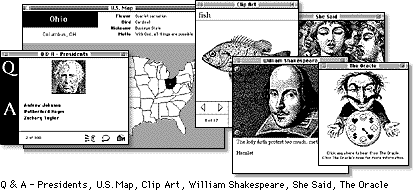
Our whole collection of free and shareware work (minus The Bee) can be downloaded at my site. I invite other HyperCard authors to not only download my work, but check out my scripts. Most scripts are fully commented and all of our stacks are wide opened (no user level limits or passwords). I'm not saying that our scripts are anything to write home about, but there might be a few interesting mechanisms in there for someone who is learning.
Tell us about your HyperCard workshops.
Over the years I've done numerous workshops on all aspects of using
Macintosh computers, but I enjoy none more than teaching HyperCard. Over
the past ten years I've led hundreds of workshops in HC development. I've
led HC workshops at all the national and regional ed and special ed conferences.
I try to transmit some of Bill Atkinson's spirit in each workshop or
course. HyperCard development is a unique experience in Mac-dom and I want
my students to get a taste of that.
It's very exciting to witness people all of a sudden, after days of
work, grok how beautiful and elegant HyperCard is as a tool. It's a teacher's
dream in that there is always more to teach and the teacher does not have
to know all the answers, just how to experiment and find answers through
trial and error.
Are your workshops primarily for people in the disabilities community?
Yes they are. In fact, many people in the disabilities community know me as the "HyperCard guy." I've taught people how to make various picture/word language-related stacks, story stacks, and other simple stacks that might be used by a person who doesn't read well.