Home | Interviews Index
page 1 | page
2 | page 3
Who takes these courses?
I teach a variety of people at these conferences: people with disabilities (consumers of the technology) and professionals (teachers, speech pathologists, occupational therapists, etc.; some of whom have disabilities themselves).
Why is HyperCard useful to people with disabilities?
HyperCard can be a useful tool for for writing, organizing, and scheduling, and can make a big difference in the lives of people with language and learning differences. Tools such as HyperCard help people compensate for various writing and organizational problems, and that helps them participate in the world of paper, appointments, meetings, and so forth.
Do peoples' disabilities affect how they use HyperCard?
Some of the workshops involve making HyperCard stacks accessible to people who can't use a mouse to point (imagine physicist Stephen Hawking, for example) but can make a click using either the button on a mouse or another kind of button (in the industry, called a "switch"). If a person can click but not point, you can make things accessible to them by having all of the choices scan.
What do you mean by "scan"?
Scanning is the sequential highlighting of buttons: choice a, choice
b, choice c...
 The scan continues a, b, c, a, b, c... until the user clicks the mouse/switch.
Then either something happens or a new set of scanning choices appears.
The scan continues a, b, c, a, b, c... until the user clicks the mouse/switch.
Then either something happens or a new set of scanning choices appears.
Making stacks scan for people with physical disabilities was what I
was asked to teach in the early years of HyperCard. Physical access is
not an area that I'm an expert in but I came up with lots of generic scripts
that I could teach people how to incorporate into their stacks to make
them accessible to switch users.
How could people find out more about button scanning?
I have a friend, Bill Lynn, who's a HyperCard and HyperStudio developer who has a web site with all sorts of resources for switch users. It's the Simtech Publications site and you can download a free stack called "HyperCard Button Scanning Tutorial" that teaches users how to make various kinds of scanning scripts.
Are you still teaching HyperCard workshops?
I teach a week-long HyperCard development course at the University of
Southern Maine each summer as I have been for the past five years, but
unfortunately there's been less interest in HyperCard workshops lately.
It's partly due to the fact that Roger Wagner has done a great marketing
job in marking HyperStudio to grades K-12, and partly because HyperCard
has not kept up with the times. The biggest problem has been the lack of
support from Apple and Claris for people doing things with HyperCard.
When Dan Eilers (the head of Claris then) was considering dropping
HyperCard, I joined with Danny Goodman (and hundreds of others) in a letter-writing
campaign to Eilers to save HyperCard. HyperCard wasn't dropped, but there
seemed to be very little support for it at Claris.
I've presented on HyperCard at Macworld (both Boston and San Francisco)
off and on for the past ten years. I led the HyperCard in Education panel
a number of times until the Expo finally dropped HyperCard as a session
topic. Okay, Macworld is more about trade show, less about presentations,
but still, the fact that they dropped it as a topic and no one stood up
and complained (that I know of) says something.
That must have been discouraging.
I've been working with HyperCard since the beginning and I still develop
with it, but I was starting to lose hope.
I'm glad that you made this web site and I'm glad to see there are
many others who are still using and enjoying this great tool. Perhaps HC
3.0 will be a new beginning for HyperCard.
It sounds as though the Macintosh and HyperCard have been important elements in your life.
Becoming an artist changed my life in 1975 by showing me that I could
make and share things with other people that in some way represented my
intelligence. I felt smart for the first time in my life.
The Macintosh changed my life again in 1984 by allowing me to do enough
writing and reading to learn from my own experience. In doing that I felt
smart for the second time in my life.
HyperCard changed my life again in 1987 by showing me that I could
actually learn how to make complex and (hopefully) elegant things that
others liked. HyperCard development to me feels more like doing art than
programming. Given my background its easy to see why I'm so in love with
it.
What are your future plans?
I spend a considerable amount of time away from home teaching and presenting. I do enjoy presenting, but the travel gets old after a while. I've been working on a book for the past few years and I hope to finish it in the next year and maybe, if it's successful, it will allow me to stay home and do more writing and stack development.
What would you like to see in HyperCard's future?
Over the years I've wanted to organize a HyperCard get-together to meet other authors and to try to generate some of that original enthusiasm. Maybe you could help organize something like that through HyperCard Heaven. We could make a time and place for many of us HyperCard loyalists to get together and have some fun sharing.
That sounds like a terrific idea!
I wish everyone from Apple on the HC development team the best of luck
in making 3.0 a continuation of the great tradition Bill Atkinson started
way back when.
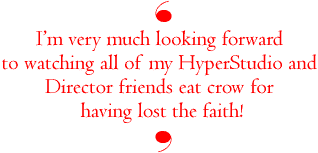
I'm very much looking forward to watching all of my HyperStudio and
Director friends eat crow for having lost the faith!