
 rian Thomas is a pioneer in interactive media. In 1988 he and Philip
A. Mohr Jr. released a collection of HyperCard stacks they called If
Monks Had Macs... . (Brian did the writing and design; Philip scripted
and enhanced them.) The freeware collection quickly became an underground
legend. MacUser said, "If Monks had Macs... is one of
the most beautiful and elaborate works in HyperCard."
rian Thomas is a pioneer in interactive media. In 1988 he and Philip
A. Mohr Jr. released a collection of HyperCard stacks they called If
Monks Had Macs... . (Brian did the writing and design; Philip scripted
and enhanced them.) The freeware collection quickly became an underground
legend. MacUser said, "If Monks had Macs... is one of
the most beautiful and elaborate works in HyperCard."
 Brian, along with a group of volunteers known collectively as riverText,
continued to expand and upgrade Monks over the years. In a 1992
survey of industry movers and shakers, Monks was the highest-rated
non-commercial educational software program.
Brian, along with a group of volunteers known collectively as riverText,
continued to expand and upgrade Monks over the years. In a 1992
survey of industry movers and shakers, Monks was the highest-rated
non-commercial educational software program.
 The Voyager Company published a greatly expanded Monks on CD-ROM
in 1995. (At the Voyager web site
you can download
a 1.1 MG demo stack on their Monks
page.) Entertainment Weekly Review called it "engrossing"
and "addictive." MacWeek said, "If Monks Had Macs...
has been considered by multimedia mavens to be a seminal work of hypermedia
art, juxtaposing serious and fun topics and using links in a creative as
well as educational way."
The Voyager Company published a greatly expanded Monks on CD-ROM
in 1995. (At the Voyager web site
you can download
a 1.1 MG demo stack on their Monks
page.) Entertainment Weekly Review called it "engrossing"
and "addictive." MacWeek said, "If Monks Had Macs...
has been considered by multimedia mavens to be a seminal work of hypermedia
art, juxtaposing serious and fun topics and using links in a creative as
well as educational way."
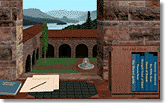
So what is Monks? Your home base is a desk in a monastery library.
You're greeted with the timeless beauty of a Gregorian chant and the gentle
splashing of the cloister fountain outside your window. On your desk is
a revolving bookcase which holds 24 volumes. In these volumes you'll find
an astonishing collection of interactive essays, books, games, music, art,
and even a hypertext journal.
Without a doubt, If Monks Had Macs... is one of the most sophisticated
and successful HyperCard programs ever created.
~ ~ ~ ~ ~
Can you tell us a little about your background?
I attended the University of California at Santa Barbara just before the
age of personal computers (but, fortunately, not before the age of erasable
typewriting paper). I had the opportunity to passionately read a lot of
great literature as I earned my English major's Bachelor of Arts degree,
but I learned to leave the degree off my job applications as upon graduation
I sought employment only in the world of blue-collar labor.
 This paper doll I cut 12 years ago in an industrial park in Southern
California shows you just what kind of work I found:
This paper doll I cut 12 years ago in an industrial park in Southern
California shows you just what kind of work I found:
Unfolding the doll again brings those years of tabbing four-color separations
of ads from Newsweek, Business Week, Sports Illustrated, and U.S.
News and World Report for the world's largest printing company. The
frantic nudging of the negative too far in either direction, that desperate
tedium was relieved occasionally by a worker holding up -- to a chorus
of whistles and cat-calls -- the color proof for an ad featuring a particularly
bodacious babe.
One day in 1984 I thrust up a proof for the first Macintosh ad, the
one that showed how to design tennis shoes in MacPaint. The ad's headline
my memory has rearranged into the promise, "You too can be a knowledge
worker." The guys looked at each other in disgust and someone might
have whispered, "Hey, come quick, Brian is losing it." Since
I could barely communicate with some of the people who worked in the same
room with me, it's unclear why I thought buying a computer would enable
me to communicate with the world outside that room.

So you bought a Mac?
Yes, and with my new Mac Plus I made fake company memos that satirized
our multi-national corporation's contempt for us workers. I'd arrange to
have the fake pronouncements posted in the middle of the night on bulletin
boards throughout the plant so that the next day I'd see my fellow workers
eagerly reading, copying, and collecting my memos.
 The first interactive program I created was a Pinball Construction
Set template called "Tabbing Thomas." All I could put up on the
company bulletin boards was an ad for the game (that I put up the day I
quit my job ).
The first interactive program I created was a Pinball Construction
Set template called "Tabbing Thomas." All I could put up on the
company bulletin boards was an ad for the game (that I put up the day I
quit my job ).
I didn't miss my old corporation's cork bulletin board for I had found
that I could upload Tabbing Thomas together with my next creation, a Reaganomics
Pinball game, on electronic bulletin board's all over the country.
What was "Pinball Construction Set"?
Pinball Construction Set, developed in the early 1980's, was a landmark
in the history of computer software. It anticipated fundamental features
of the Mac operating system such as tool boxes and drag-and-drop parts.
As with HyperCard, a freely-distributable Pinball Player was provided so
that anyone with a Mac could play your Pinball templates.
However, as exciting as Pinball Construction Set was to play with,
it had severe limitations as a platform through which to communicate challenging
ideas -- your whole argument had to be woven into four to five simple instructions
for playing the game.
What got you interested in HyperCard?
HyperCard's creation and its release as freeware by one of the most revered
members of the original Mac team, Bill Atkinson, was a much anticipated
event.
Danny Goodman's HyperCard Handbook was published a couple of
weeks before HyperCard's release. I had read the entire book by the time
I heard a rumor that Apple had at last launched their free product by sending
HyperCard disks to every Macintosh User group president. I called up the
president of the San Gabriel Valley Users Group whom I had never been met
(although I was a member of the club). I just told him that I wanted directions
to his house so I could pick up a copy of HyperCard and start building
my first HyperCard stack that evening -- a stack of illustrated notes,
like you would get caught for passing in class.
continued on next page