Home | Interviews Index
page 1 | page 2
| page 3
How would you describe your CD-ROM to someone who hasn't a clue what
it's about?
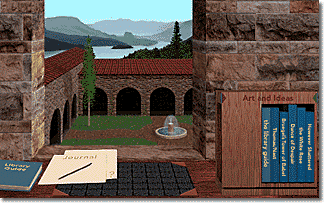
As the cloister fountain gently splashes, relax to the unearthly beauty
of a Gregorian chant and enjoy our library's view of the Oregon's Columbia
River Gorge. Or browse, on our four-sided revolving bookcase, the library's
four collections -- "Art & Ideas," "The American Renaissance,"
"The Monks' Library," and the "JFK Archives." I'll
briefly describe here just three of the CD-ROM's experiments in interactive
media.
 In the American Renaissance collection "The World of an Idea in
the Life of Henry David Thoreau" examines, from five distinct points
of view, Thoreau's life and ideas in the context of the American Renaissance
of the 1850's. The reader glides along and across five currents of thoughts
with a special browsing tool called the "thinkerToy."
In the American Renaissance collection "The World of an Idea in
the Life of Henry David Thoreau" examines, from five distinct points
of view, Thoreau's life and ideas in the context of the American Renaissance
of the 1850's. The reader glides along and across five currents of thoughts
with a special browsing tool called the "thinkerToy."
 Richard Gaskin of FourthWorld
Software and I designed the journal that comes with each copy of the
library both for the way Henry David Thoreau used a journal, and as a convenient
way to apply modern psychological techniques designed to get you beyond
any obsession with the details of your life to the creative spirit within
that can shape that content. In addition to a journal's usual chronological
order the journal entries can be linked thematically into "threads."
You can write for a year and then have journal do a series of keyword searches
to set all the entries about sailing, business decisions, or sex into separate
threads any number of which can be printed or viewed separately from the
rest of the journal. Or you can automate the keeping of a structured journal
by creating categories such as, affirmations, dreams, things that piss
you off, or anything else you might choose. The latter method of journaling
is explained in detail in a companion volume entitled, "Get an Inner
Life."
Richard Gaskin of FourthWorld
Software and I designed the journal that comes with each copy of the
library both for the way Henry David Thoreau used a journal, and as a convenient
way to apply modern psychological techniques designed to get you beyond
any obsession with the details of your life to the creative spirit within
that can shape that content. In addition to a journal's usual chronological
order the journal entries can be linked thematically into "threads."
You can write for a year and then have journal do a series of keyword searches
to set all the entries about sailing, business decisions, or sex into separate
threads any number of which can be printed or viewed separately from the
rest of the journal. Or you can automate the keeping of a structured journal
by creating categories such as, affirmations, dreams, things that piss
you off, or anything else you might choose. The latter method of journaling
is explained in detail in a companion volume entitled, "Get an Inner
Life."

Another volume, "FACTS & LIES about the Tower of Babel,"
examines a masterpiece created during the first years of mankinds' most
revolutionary idea -- multi-national capitalism. You use our "painting
navigator" to browse over 90 color enlargements of that masterpiece
-- Bruegel's insanely-detailed painting of the Tower of Babel. The "navigator"
in the upper right corner of the screen is just two QuickTime movies linked
by HyperTalk scripts. The place you click on the gray thumbnail is shown
in color to the left -- clicking on a magnifying glass icon zooms into
the painting. In the FACTS section, browse a factual introduction to Bruegel's
Tower of Babel; in LIES, discover the fictional "Notes of a Tower
Employee". Both the factual examination of Bruegel's technique and
the politics of his time, and the "fictional" entry into the
world of the painting argue that Bruegel was an astute witness to the birth
of a global economic system that now owns the entire planet.
But don't fear that even these serious subjects have put an end to
innocent delights like the old (and newly refurbished) monastery jukebox.
Expect more entertainments. In Art & Ideas, you'll find "The Dance
of Despair" an existential art puzzle game in which each dance
of despair ends in a dance of delight.

Left to right: Dance of Despair game, Monastery Jukebox, Thomas Nast,
Haiku Master.
Are there any plans to make a cross-platform version?
I'm working on a much enhanced and hopefully cross-platform version that
we call in-house, If Monks had Windows... they'd jump out of them.
I've had my hope dashed more than once by broken promises about the imminent
release of HyperCard-like cross-platform software construction kits. So
all I can promise is that there will be a final version of this, the longest
running interactive presentation in history, published within a year or
so -- even if I have to call it If Monks had Macs... PRO, instead
of If Monks had Windows...
Is riverText working on anything new?
After we published this Mac-only version of our CD-ROM I launched the riverText
cafe on the internet. Because I kept adding "cafes" until the
site was full, I renamed it Cafenet.

I have just moved Cafenet to
a spacious new virtual domain -- rivertext.com. As an antidote to the seasonlessness
of cyberspace, each week one of our pages displays a new passage
from Thoreau's journals that describes nature's current season. At
HyperCard Heaven's request I just dusted the old freeware version of the
White Rose
for cafe visitors to download.
Other things on the Cafenet menu include a rocking poetic "babble"
from punk pioneer Patti
Smith about the sculpture of Constance Brancusi, a profusely-illustrated
tribute to the poetic origins of the comic strip, a new serial translation
of Perceval, or the Story
of the Grail, and as I think it's going to be the holiday season when
this interview is published, I'll also mention that there is also a wonderful
children's xmas story about gnomes called, Scramblepipe
Tries to Understand. Out of print for many years, it was recently published
at my suggestion in a sci-fi Christmas anthology, but in paperback without
its classic illustrations.
By far the most popular riverText cafe menu item is the one introducing
the life and thought of the patron philosopher of the If Monks had Macs...
new media library, Simone
Weil. I have cornered the search engine market on a woman who increasingly
is being recognized as one of the greatest thinkers of our century.
Any final thoughts?
Your interesting decision to title this interview "Knowledge Worker"
prompts me to add that independent new media cultural history workers may
be an endangered species. I could afford to make If Monks had Macs...
without funding and let it be its feisty provocative, eccentric self, and
not just information and art fashioned for a particular marketing niche,
because I had free access to great art and literature in the public domain.
Here are a few disturbing facts:
* I just read an article on the CNN site about a copyright convention in Geneva that is working to make it possible for the first time to copyright and license facts, "the new treaties would give professional leagues ownership of sports statistics and stock markets ownership of stock tables."
* A week or two ago on the MacWeek site I read about a new PhotoShop 4 feature that can permanently and invisibly encode copyrights notices into all images. I'm all for artists protecting their own works, but what about Bill Gates who is busy buying up the electronic rights to masterpieces that are 100 to 1000 years old?
* In addition I've long been concerned about the way the Dr. Martin Luther King Jr. estate is attempting to enforce a copyright or trademark on King's image so that no one may refer to King visually without their approval.
If nothing is done to stop these trends it may come to pass one day
that no one will be allowed to refer visually to any of our civilizations
ancient dreams of beauty or modern heroes or statistically to fluctuations
in the economy without prior approval and the payment of licensing fees.
If all information is private property, only corporate sponsored entities
will have the money to become fully licensed "knowledge workers"
on the new multimedia internet. My final thought is that just as we have
been vigilant and united in the fight against censorship on the net, so
must we be resolute in the fight against merchandisers who seek to turn
our priceless cultural and spiritual heritage into a pay-per-view clip
art collection.
E-mail Brian Thomas
| Brian's web site
Monks page
at Voyager
E-mail HyperCard Heaven with your
comments about this interview.
Home | Interviews Index
page 1 | page 2
| page 3