Home | Interviews Index
page 1 | page 2 | page
3
This was your "Passing Notes" stack?
Yes, and it began, "Evolution, what a load of shit." HyperCard
seemed to be to me for this age, like the parables of the prophets, a way
to get people to consider a different view of the world. However, as the
Mac community at that time was almost entirely made up of Star Trek fans,
this should not have gone over any better than my holding up a picture
of the Mac in the print shop instead of the expected bodacious babe.
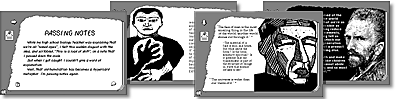
 Nonetheless, my discussion of how for modern man the theory of evolution
functions as a creation myth; how ancient practices we think we have outgrown,
we have just re-named, delighted far more Trekkies than it offended. Several
of them volunteered to help me build more such critiques.
Nonetheless, my discussion of how for modern man the theory of evolution
functions as a creation myth; how ancient practices we think we have outgrown,
we have just re-named, delighted far more Trekkies than it offended. Several
of them volunteered to help me build more such critiques.
Bill Atkinson, HyperCard's creator, wrote a letter telling me how much
he liked "Passing Notes'" style and gall. This frustrated licker
and sticker of four-color separations had become an unemployed knowledge
worker.
Bill Atkinson's letter must have been very encouraging.
Yes, I was thrilled. I celebrated by joining up with HyperCard fanatic,
Philip A. Mohr, Jr., to develop an elaborate package of fun and games and
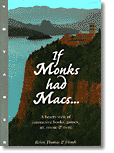
serious ideas that we collected in a virtual monastery library called If
Monks and Macs....
After "Passing Notes" we added a hypertext edition of the
medieval classic, "The Imitation of Christ," a sophisticated
journal so that our readers could listen to their own thoughts, a medieval
adventure game, the monastery jukebox, and a series of volumes on the suppressed
facts about the Kennedy assassination.
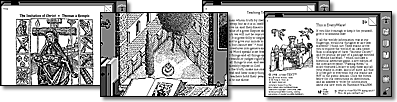
You can download the freeware version of The
Imitation of Christ (522 K) from the Thomas à Kempis page in
the Christian Classics Ethereal Library.
Note the original black-and-white illustration of the monastery library
on the second card from the left.
The most popular volume of the original library was an introduction
to how the White Rose resistance group published an underground newsletter
declaring the true reality of Hitler's war in Nazi Germany while the Gestapo
hunted them down. The current CD-ROM version was done with the help of
one of the few surviving members of the White Rose.
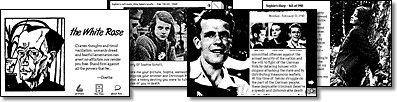
You can download the freeware version of the White
Rose from Brian's web site.
The company of volunteers that assembled to build and test this stuff
we called riverText -- a name I hope suggested a more natural and purposeful
hypertext.
 How did this group of volunteers come together?
While I lived in Southern California I met Philip A. Mohr Jr., Kevin Lossner,
Steve Grass and the rest of my original co-conspirators through the San
Gabriel Valley Mac Users Group and its electronic bulletin board. Richard
Gaskin, I met at the Los Angeles Mac Users Group and Bob Woods, I met at
the Portland Mac Users Group.
How was Monks distributed?
The disk-based version of If Monks had Macs... and our Kennedy assassination
archives were distributed on from two to seven disks as Everyware -- if
you like this enough to keep if for yourself, share it with someone else.
Did you anticipate it becoming a commercial product someday?
No, I was proud that Monks was better, when it was first released,
in many ways than any commercial HyperCard product, but then HyperCard
was also better than any other new media authoring application and it was
free, too.
Since Monks was freeware, what motivated you and the others to
do all the work necessary to create it?
The Gregorian chant that greeted visitors to even the first version of
the monastery library belied the fact that I was largely inspired to build
the library by going to LA's vibrant punk rock shows and feeling that I
was doing the same kind of thing with computers that groups like the Minutemen
did to the Rock of the 70's. I saw myself as one worker seizing the means
of production and distribution of information and ideas from corporate-sponsored
"culture-vultures." I felt like having fun.
Some others had this great HyperCard toolkit they were dying to make
things with, but weren't quite sure what they wanted to build with it.
I knew what I wanted.

What response did you receive when Monks... was released?
If you think of If Monks... as a music CD, "The White Rose"
volume was our hit single. Several people wrote to tell me that interacting
with it was the first time they'd cried in front of a computer screen.
In the beginning, however, our new media library did not get any recognition
from the official Macintosh news media. The significance of this is difficult
to grasp today when one would naturally ask, "Well, of course, why
would you expect them to mention your freeware HyperCard stack?" But,
then, HyperCard was, within the Mac press, what the Net is today. Magazines
were filled with write-ups of HyperCard stacks designed to collect toe-nail
clippings or catalog fluff. Whole magazines sprung up do nothing else but
this, and present lessons in HyperTalk. If Monks had Macs... simply
didn't fit into any editor's pigeon-hole.
To the dismay of the judges of the first MacWorld SuperStack contest,
the first volume of Monks was, after being officially qualified
as a finalist, removed from the contest by a MacWorld editor simply because
it was deemed "quirky." That changed the following year when
at least one judge accused MacWorld of censorship in regards to this decision
and we were asked to resubmit the first volume along with any new work.
We won three SuperStack awards that year.
In December of 1992 MacUser named our library as one of "200 Best
Macintosh Products."
How did Voyager become your
publisher of the CD version of Monks?
The first freeware edition of If Monks had Macs... was released
several months earlier than Voyager's landmark first CD-ROM, Beethoven's
Ninth. At least a few people at Voyager had been startled to experience
the five-volume freeware If Monks had Macs... new media library
as they put the final touches on the seminal Beethoven's Ninth CD-ROM.
When it was released, the Beethoven's Ninth CD-ROM was hailed as
"the first interactive work worth criticizing" and I could understand
why Voyager believed that it was the first interactive work that mattered.
 After one of the first public presentations of Beethoven's Ninth
I walked up to the Voyager team and said with a smile, "Thank you
for making Beethoven's Ninth. I'm so glad that I, at last, have
some competition." When the boggled look faded a bit from their faces
I told them that I had authored If Monks had Macs... It meant a
lot to me that Bob Stein and Robert Winter sort of nodded in astonishment
that such an unlikely world actually had an author and accepted me as a
colleague.
After one of the first public presentations of Beethoven's Ninth
I walked up to the Voyager team and said with a smile, "Thank you
for making Beethoven's Ninth. I'm so glad that I, at last, have
some competition." When the boggled look faded a bit from their faces
I told them that I had authored If Monks had Macs... It meant a
lot to me that Bob Stein and Robert Winter sort of nodded in astonishment
that such an unlikely world actually had an author and accepted me as a
colleague.
At each San Francisco Mac Expo I would hand Voyager's director, Bob
Stein, the latest hand-copied floppy containing an edition to the library
and he would give me a shrink-wrapped Voyager disk. I refused at that time
to consider commercial distribution of If Monks had Macs...
What changed your mind?
Poverty.
 In 1990 I sold my condominium in Los Angeles, vowed never to see the
inside of a print shop again, and moved to Portland, Oregon. In Portland
in 1990 you could still buy a new color Mac system, a flat-bed scanner
and a used four-bedroom Victorian in good condition for less than $30,000.
I painted the Victorian seven shades of green, and considered it a truly
excellent and practical computer case. HyperCard scripting-experts Richard Gaskin and Kevin
Lossner, and multimedia illustrator Bob
Woods, helped me expand the eight freeware stacks into a 24-volume
CD-ROM library of interactive entertainments.
In 1990 I sold my condominium in Los Angeles, vowed never to see the
inside of a print shop again, and moved to Portland, Oregon. In Portland
in 1990 you could still buy a new color Mac system, a flat-bed scanner
and a used four-bedroom Victorian in good condition for less than $30,000.
I painted the Victorian seven shades of green, and considered it a truly
excellent and practical computer case. HyperCard scripting-experts Richard Gaskin and Kevin
Lossner, and multimedia illustrator Bob
Woods, helped me expand the eight freeware stacks into a 24-volume
CD-ROM library of interactive entertainments.
When I told Bob Stein I was looking for a publisher and an advance
he was eager to publish the first commercial version of our new media monastery
library.
concludes on next page